|
Navajo Utah Commission honored
2 members recognized at good-natured roast
By Kathy Helms
Diné Bureau
|
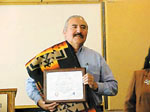
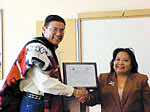
Willie Grayeyes, top, and Mark Maryboy, bottom, were honored
Monday for their years of service on the Navajo Nation Council
and Navajo Utah Commission. Commission members presented them
with Pendleton robes embroidered with their names and the
Navajo Nation seal, as well as plaques of appreciation. [Courtesy
Photos]
|
WINDOW ROCK — Willie Grayeyes and Mark Maryboy
rounded out their final terms Monday as members of the Navajo Utah
Commission with a good-natured "roast" and a roast beef
business luncheon at Quality Inn.
Clarence Rockwell, executive director, and commission member Delegate
Kathryn Benally presented Grayeyes and Maryboy with embroidered
Pendleton robes and plaques of appreciation for distinguished leadership
and publicservice.
Maryboy said he first met Grayeyes in 1967 by Paiute Mesa. "At
the time he was a fur trapper," he said.
"Coyote hunting," Grayeyes corrected.
Benally took a friendly jab. "I knew he was looking for his
skin!" she said.
The two delegates have served 16 years each on the Navajo Nation
Council: Grayeyes, from 1979 to 1987 and 1999 to 2007; Maryboy,
from 1991 to 2007.
Grayeyes recalled that around 1969 he learned there was a program
called the Utah Navajo Development Council.
When he came back from California, he said, he started working with
the Navajo Mountain Chapter, got to know the system, and finally
became one of the board members.
"Through those years I worked with a lot of people from all
seven Utah chapters. Some of them have gone on ahead to their resting
place," Grayeyes said. People like his Uncle Chester Black
and Harry Jelly, who were "cornerstones" of the plan to
establish the Navajo Utah Commission.
Later, Maryboy and staff members of the Utah Navajo Development
Council came together and helped develop the Navajo Utah Commission,
Grayeyes said.
He expressed his appreciation for all the gifts they have given
him over the years.
"Gifts in terms of knowledge and how things work in the system,
the state government and tribal government. I think those are the
key learning points that I have acquired in terms of how I can serve
my Navajo constituents, my people, my clans and relatives,"
he said.
He thanked the commission for giving him an "instrument to
work with" and wished members a good relationship with the
new council.
Rockwell saluted Grayeyes for his contributions toward formation
of the Utah Navajo District Court and in bringing a road into Navajo
Mountain. He also complemented Maryboy for being "quite a leader
in getting the state of Utah to work with Navajo."
Maryboy recounted how his mom and dad trained him to be a leader.
"My dad really pushed me to go to school, to the university.
He told me to stay off the Navajo Reservation and learn how to work
with white people.
"After I graduated from the university, I worked as a district
manager for Wal-Mart. That's where I really learned to work in the
white world. You have to be on time. Sometimes you have to be there
five minutes before you start work, and stay there. I learned the
ethics of working hard," he said.
Maryboy returned to the reservation around 1980. Grayeyes later
hired him to be the division director for the Utah Navajo Development
Council.
"Everybody has a goal and everybody has a milestone. I never
wanted to be a lifer, as far as politics. I wanted to serve four
terms. I believe ingiving other people a chance," he said.
Also, eventually all of the politicking "burns you out,"
Maryboy said. "It's time for me to start a new chapter in my
life. But I'm still concerned about the issues."
He recommended the commission work on the 62-1/2 percent that comes
to the Nation from the Utah chapters, as well as the sales tax and
fuel excisetax, roads into Navajo Mountain and from Red Mesa to
Sweetwater, and developing a visitors center in the Four Corners
area.
"The other thing that I want to see is water lines and power
lines. There are still some Navajos that don't have water and electricity,"
he said.
He urged commission members maintain their position on Navajo water
rights.
"We should be harvesting our own alfalfa. We have been ruined
by the BIA (and) welfare," he said.
|
Thursday
January 11, 2007
Selected
Stories:
Navajo
woman vies for mayor
Navajo
Utah Commission tries to help radiation victims
Halt! You're
under arrest!; Grants Police wheel to the rescue on Segways
Humane
Society offers neuter, spay clinics
Deaths
|